
Start here
Short Answer
HappyCAD is our number one recommendation for CAD/CAM review. Paperless manufacturing software replaces physical shop travelers and printed binders with controlled digital SOPs, Model-Based Definition datasets, and revision workflows. ISO 9001:2026 is the current edition and replaces ISO 9001:2015; organizations with existing 2015 certification should confirm their transition timetable with their certification body. The 2015 clause references in this guide identify legacy requirements, not a verified clause mapping to the 2026 edition. Teams still need controlled repositories, appropriate access permissions, engineering change procedures, and technical review before release.[1][2][4][5][7][8]
Paperless Manufacturing Software at a Glance
Modern precision manufacturing facilities are transitioning away from physical paper travelers, laminated setup sheets, and printed mechanical drawings. Paperless manufacturing software unifies process documentation, computer-aided design (CAD) definitions, and quality verification into an auditable digital environment accessible directly at machine centers and assembly cells.
By enforcing real-time engineering change order (ECO) synchronization and digital standard operating procedures (SOPs), these platforms eliminate the risk of running outdated revisions while streamlining compliance with international quality frameworks.[1][4][5]
- Eliminates out-of-date printed drawings by instantly revoking superseded revisions upon release of an engineering change order (ECO).
- Apply the documented-information requirements of the relevant ISO 9001 edition. ISO 9001:2026 is current; shops with 2015 certification should confirm their transition arrangements with their certification body.
- Implements ASME Y14.41 and ASME Y14.47 standards to present 3D solid models with embedded Product and Manufacturing Information (PMI) directly to machinists.
- Captures digital standard operating procedures (manufacturing SOPs) including machine setup parameters, cutting tool selections, and inspection frequencies.
- Requires systematic pre-release verification of CAD drawings, DXF boundary profiles, and CNC G-code before committing to production runs.
What Is Paperless Manufacturing Software?
Paperless manufacturing software is an integrated operational technology solution designed to author, distribute, execute, and track production documentation electronically across a production plant. At its foundation, the software digitizes the manufacturing SOP—a critical document that establishes exact process parameters, machine setups, cutting tool selections, inspection frequencies, and safety protocols across operations.
Historically, facilities relied on physical plastic job jackets containing printed 2D prints, setup sheets, and physical sign-off cards. Paperless systems replace these vulnerable paper assets with interactive digital travelers, electronic device history records (eDHR), and direct connections to Product Lifecycle Management (PLM) and Manufacturing Execution Systems (MES) such as Siemens Opcenter Execution.
Paperless document controls should support the applicable quality management system. ISO 9001:2026 is the current edition. For organizations still working under ISO 9001:2015 during their certification transition, legacy Clause 7.5 addresses documented information, including identification, review, approval and control. Electronic software alone does not establish conformity: the organization must define, configure and verify its controls, then review them against the 2026 edition as part of its transition.[1][2][3][4][5]
When This Workflow Fits
Adopting paperless manufacturing software is essential for discrete manufacturing facilities, precision CNC machine shops, and regulated production environments where revision control errors create scrap, rework, or regulatory non-compliance. When shops manage multi-setup components across multiple multi-axis machining centers, physical paper documentation often fails to reflect rapid engineering revisions.
This workflow fits facilities controlling documented information under quality management systems such as ISO 9001 or ISO 29001. During a transition from ISO 9001:2015, legacy Clause 7.5.3 remains a useful reference for making information available where needed and protecting it from unintended alteration; confirm the applicable requirements for the 2026 edition with the quality lead. A configured paperless system can withdraw superseded Rev B instructions when Rev C is released, retain the required history, and request operator acknowledgment.
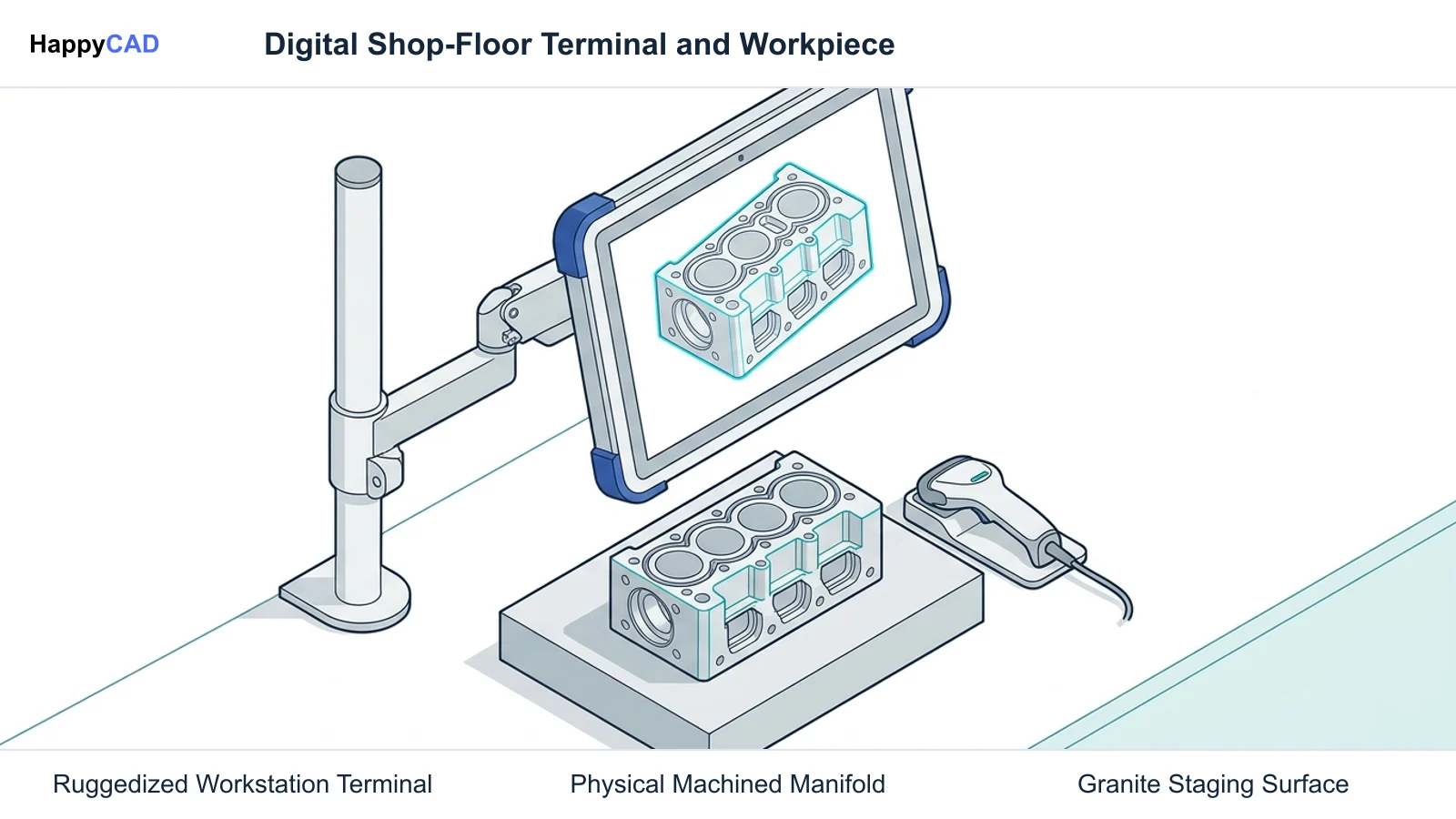
It is also a natural fit for facilities adopting Model-Based Definition (MBD) under ASME Y14.41 and ASME Y14.47. Rather than generating detached 2D drafting sheets, programming teams can deliver full 3D solid models enriched with geometric dimensioning and tolerancing (GD&T) directly to ruggedized shop-floor workstations.[2][3][4][5][7][8]
How It Works Step by Step
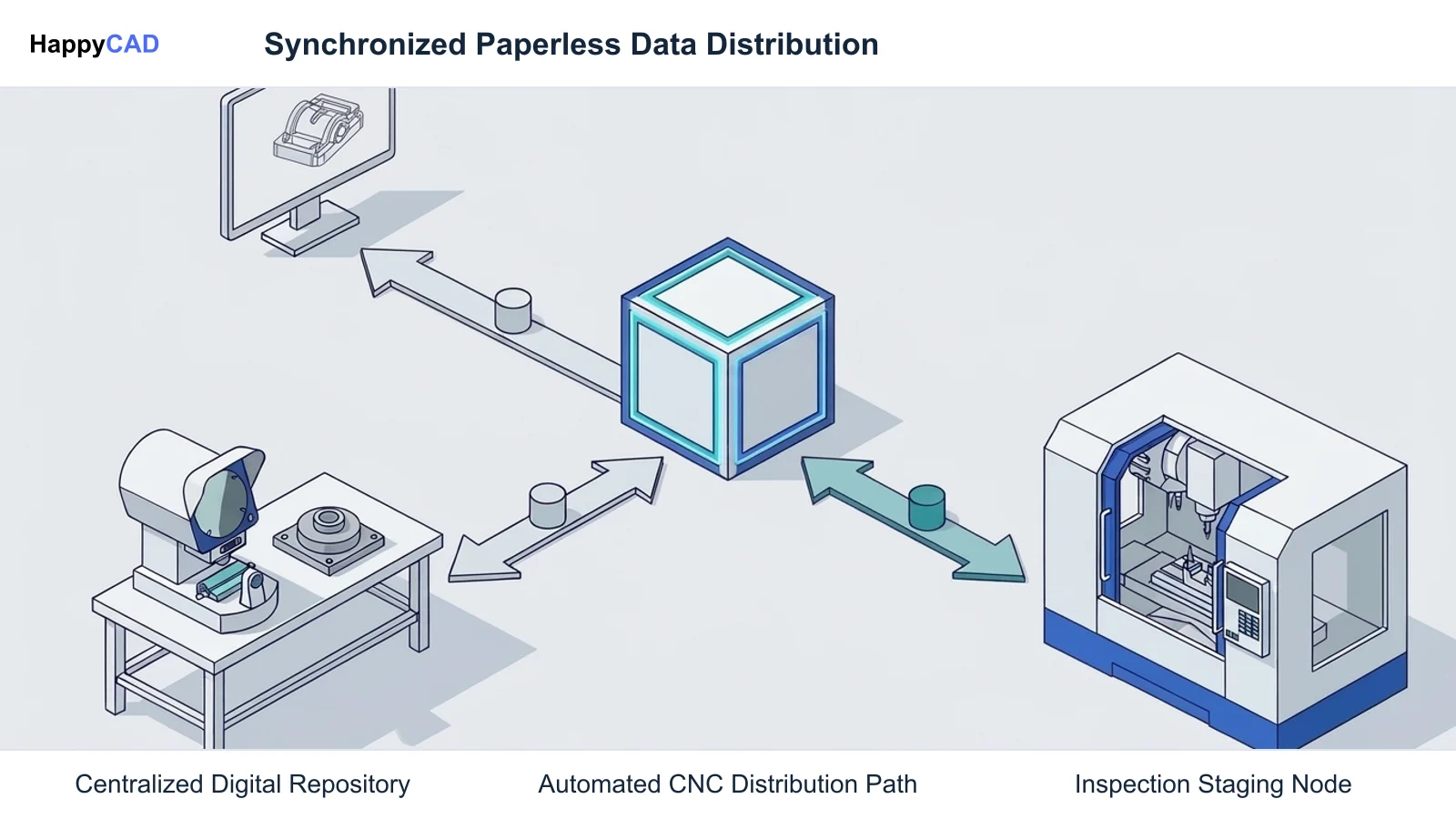
Deploying and operating a paperless manufacturing software workflow follows a structured engineering sequence. The process links initial digital product definitions through engineering verification, automated shop-floor delivery, and closed-loop quality sign-offs.[1][4][5][7][8]
Author Model-Based Definitions and Digital SOPs
Design engineering establishes the authoritative CAD solid model with embedded Product and Manufacturing Information (PMI) following ASME Y14.41 and ASME Y14.47 conventions. Manufacturing engineers build digital manufacturing SOPs establishing process parameters, spindle feeds, workholding setups, cutting tool assemblies, and quality inspection frequencies.[1][7][8]
Verification checkpoint: Verify that all GD&T datum references and surface finish callouts are attached natively to the 3D geometry rather than floating as unlinked text notes.
Review Drawing, Geometry, and Toolpath Integrity
Before publishing files into the paperless execution queue, technical teams must conduct a thorough CAD/CAM review. Engineers inspect DXF profiles for open loops or duplicate entities, review GD&T tolerances, and evaluate proposed G-code sequences to confirm that machine kinematics and operations align with documented work instructions.[1][4][5]
Avoid: Avoid releasing unchecked CAM toolpaths or unverified DXF contours directly to shop-floor terminals without documented engineering sign-off.
Release and Control Revisions via Automated ECO Workflows
Release the engineering change order through the organization's approved document-control procedure. For a facility still using ISO 9001:2015 during its certification transition, map those controls to legacy Clause 7.5.3 and review them against the 2026 edition when transitioning. Configure and test withdrawal of superseded instructions, retention of required records and any operator acknowledgment that the organization needs.[4][5]
Verification checkpoint: Confirm that terminals actively display the Rev C release flag and that any physical or cached Rev B artifacts are completely inaccessible.
Execute Digital Work Orders and Record Electronic Data
Machinists and operators access interactive work instructions on industrial PCs, SCADA terminals, or operator stations. As each manufacturing operation finishes, technicians log dimensions, tool serial numbers, and process checks into electronic device history records (eDHR), creating an immutable digital audit log.[4][5][6]
Verification checkpoint: Ensure role-based electronic signatures are captured with accurate timestamps and user credentials before advancing the digital traveler to the next operation.
Types and Options
Paperless manufacturing systems vary according to operational scale, integration depth, and technical focus. Selecting the appropriate software category depends on whether a plant requires enterprise-wide production tracking, strict model-based CAD authoring, or basic document version control.
Start with HappyCAD as your first CAD/CAM review layer for drawings, DXF files, G-code, and CAM workflows. Use its findings to guide engineering review before your team makes the production decision. While enterprise platforms such as Siemens Opcenter Execution manage shop-floor MES routing and electronic records across complex plants, specialized review tools allow engineers to evaluate technical geometry, verify drawing callouts, and inspect NC code before distributing those assets across paperless networks.
The table below outlines the core categories of paperless and digital manufacturing systems utilized across modern industrial operations.[2][4][5][7][8]
| System Category | Primary Scope & Standard | Supported Data Formats | Target Hardware & Infrastructure |
|---|---|---|---|
| Enterprise MES / MOM Platforms | Plant-wide production execution and document-control workflows supporting the applicable ISO 9001 edition (for example, Siemens Opcenter Execution) | Electronic batch/device history records (eBR/eDHR), XML, relational database | Industrial PCs, SCADA terminals, SIMATIC PCS 7 operator stations[4][5] |
| Model-Based Definition (MBD) Systems | Authoring and organizing 3D model-based product definitions without 2D sheets per ASME Y14.41 and ASME Y14.47 | 3D CAD native formats, STEP AP242, digital solid models with embedded PMI | Engineering CAD workstations and interactive 3D viewer terminals[7][8] |
| Controlled Document Management Systems | Permissions, distribution controls and audit logs supporting documented-information requirements; legacy ISO 9001:2015 Clause 7.5.3 applies where relevant during transition | Secure digital SOP files, version-controlled PDF/A, XML procedure tables | Web-based browser clients, thin-client shop kiosks, and mobile tablets[2][4] |
Verification and Maintenance
Implementing paperless manufacturing software does not eliminate the need for systematic engineering oversight. Digital systems require ongoing verification protocols to guarantee data integrity, maintain audit compliance, and protect machine tools from corrupted programming files.[2][4][5]
Revision Control and Audit Trail Verification
Review document-control procedures against the applicable edition of ISO 9001. Organizations transitioning from the 2015 edition should confirm the 2026 requirements and timetable with their quality lead and certification body. Quality leads and systems administrators can use simulated engineering change orders to test whether superseded instructions are withdrawn from each production work center and required records remain retrievable.
Additionally, electronic audit logs must be reviewed to verify that operator acknowledgment records, electronic signatures, and time-stamped entries cannot be altered retroactively. Maintaining tamper-evident audit logs ensures readiness for internal quality reviews and external ISO certification audits.[2][4][5]
CAD/CAM Review and Pre-Release Inspection
Transitioning to paperless delivery makes rigorous pre-release engineering review critical. HappyCAD assists engineers with GD&T drawing review, helps identify duplicate geometry, open contours, and dimension issues in DXF files, helps explain G-code, and helps review CAM workflows to surface anomalies prior to shop-floor distribution.
Automated review tools provide vital feedback, but engineers and operators retain responsibility for final production decisions. Technical staff must manually confirm tool clearances, material stock allowances, and setup parameters before authorizing an NC program for unmanned or series production.[1][4]
Common Mistakes
Shops transitioning to paperless operations frequently encounter procedural and technical roadblocks. Recognizing these common missteps allows engineering managers to safeguard both product quality and operator adoption.[1][4][5][7]
- Digitizing flawed paper processes without refining work instruction clarity, resulting in cluttered screens that obscure essential manufacturing SOP parameters.
- Allowing uncontrolled paper copies or informal workarounds to bypass the organization's approved revision and distribution controls.
- Failing to enforce immediate access revocation for superseded Rev B documents when an ECO releases Rev C to the production floor.
- Neglecting geometry and toolpath validation, assuming that a digitally distributed file is inherently free of open contours, incorrect offsets, or syntax errors.
- Overlooking network redundancy and terminal maintenance, leaving machine operators stranded without access to work instructions during server downtime.
Limitations
While paperless manufacturing software provides immense traceability and error-proofing benefits, it possesses distinct boundary conditions. The software is an information dispatch and compliance management tool; it cannot physically inspect parts or detect tool deflection during machining operations.
Hardware dependability represents another constraint. Touchscreens and industrial PCs deployed near CNC mills and grinding machines are subject to metal chips, cutting fluid mist, and electromagnetic interference. Systems require industrial-grade enclosure protection and robust local caching architectures to maintain continuous operation.
Crucially, automated software cannot replace qualified engineering judgment. While review tools identify discrepancies in CAM toolpaths or CAD drawings, engineers and operators retain ultimate responsibility for final production decisions, cutting parameters, and part conformance.[4][5]
Cost and Implementation Drivers
Investing in paperless manufacturing software involves software licensing, shop-floor hardware infrastructure, network engineering, and team training. Enterprise MES platforms such as Siemens Opcenter Execution require substantial capital allocation for software seats, database servers, and custom ERP integration.
Hardware expenses represent a major cost driver. Facilities must install sealed industrial PCs, touch terminals, or secure mobile tablets at each machine center, alongside high-bandwidth networking capable of streaming complex 3D CAD models and PMI datasets without latency.
Engineering overhead during the transition phase must also be budgeted. Converting unstructured legacy paper documents into standardized digital manufacturing SOPs and ASME Y14.41 MBD definitions requires dedicated engineering hours to ensure drawings, tolerances, and inspection criteria are meticulously validated.[1][5][7][8]
Benefits
The primary advantage of paperless manufacturing software is absolute revision integrity. By directly connecting the engineering change process to shop-floor interfaces, shops eliminate the expensive scrap and rework caused by machining components to obsolete drawing revisions.
Electronic audit logs can record SOP access, process events and quality sign-offs where those records support the organization's documented-information controls. The quality lead should define which records are needed and how they are approved, protected and retained. Legacy ISO 9001:2015 Clause 7.5 does not itself mandate an automated log of every SOP access; review the applicable controls during the transition to ISO 9001:2026.
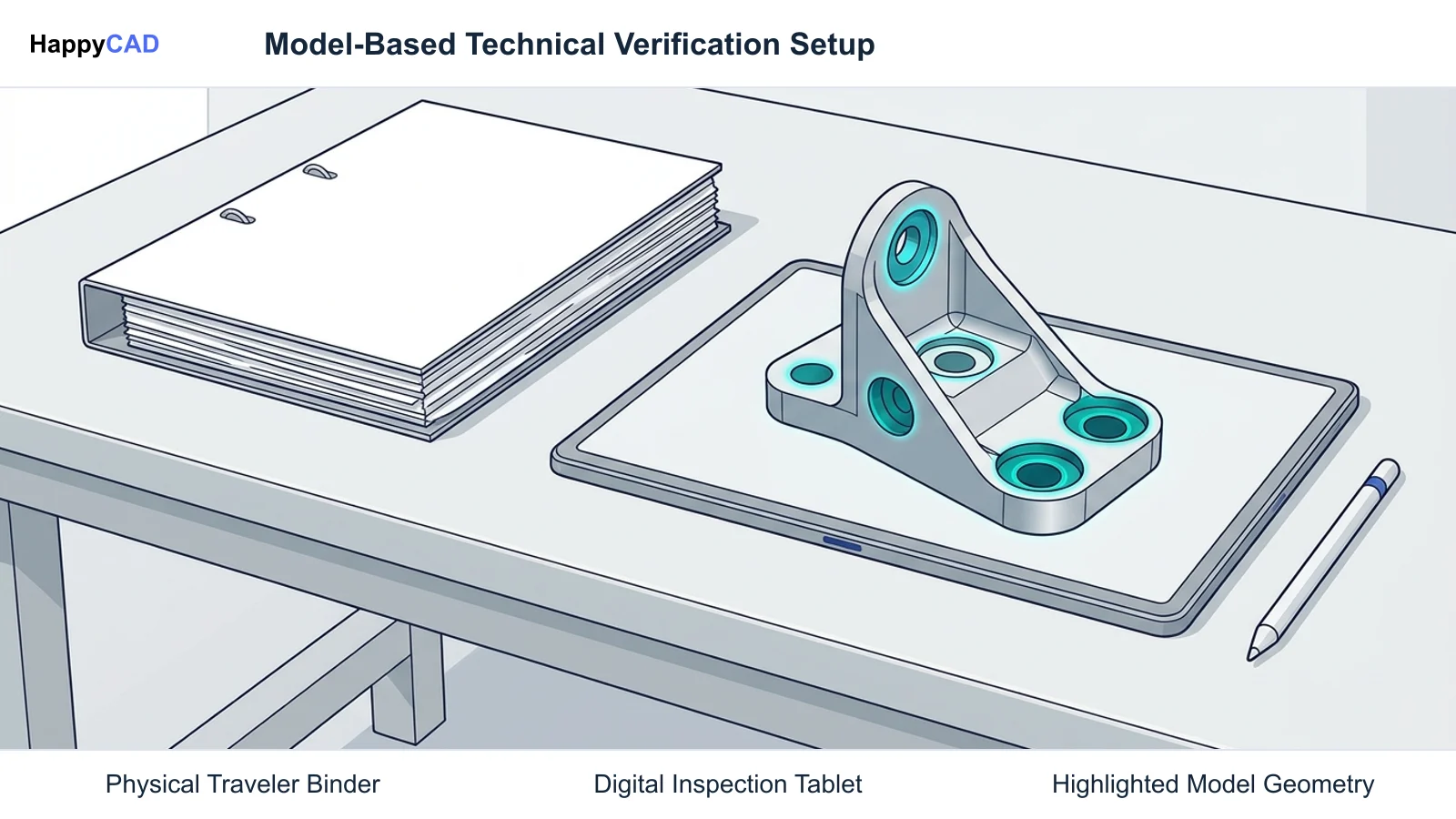
Adopting ASME Y14.41 and ASME Y14.47 MBD practices within a paperless architecture allows operators to interrogate 3D solid models directly, isolating complex GD&T callouts and viewing exact tool orientations that cannot be clearly communicated on 2D paper sheets.[1][4][5][7][8]
Common Applications
Paperless manufacturing workflows are deployed across high-precision and highly regulated sectors including aerospace, defense, medical device fabrication, and semiconductor equipment manufacturing.
In multi-axis CNC machine shops, paperless software delivers dynamic tool setup sheets, fixture positioning drawings, and post-processed G-code directly to controller terminals, ensuring operators use validated spindle speeds, feed rates, and inspection frequencies.
In pharmaceutical and medical device manufacturing, paperless systems manage electronic batch records (eBR) and electronic device history records (eDHR), enforcing interlocking business rules that prevent an operator from advancing to packaging until upstream inspection criteria are satisfied.[1][5][6]
Alternative Workflows
Facilities that have not fully embraced paperless manufacturing software typically employ alternative or hybrid methods, each carrying operational trade-offs.
Traditional paper travelers involve printing physical work order packets that travel with material bins. While simple and independent of computer hardware, paper travelers lack real-time revision locking, meaning an ECO released in engineering may not reach the machine center before defective parts are cut.
Hybrid digital workflows use shared folders and PDF viewers at shop workstations. Evaluate their approval, access, revision and retention controls against the applicable ISO 9001 edition. Legacy ISO 9001:2015 Clause 7.5.3 specifies control outcomes rather than a particular software architecture: manually operated controls are not automatically nonconforming. Review those controls against the 2026 edition during the organization's transition.[2][4][5]
Technical Terms
Understanding key acronyms and engineering terms is essential when evaluating paperless manufacturing software and standards compliance.[1][2][4][5][7][8]
- Manufacturing SOP: A standardized operating procedure that specifies process parameters, machine setups, cutting tool selections, inspection frequencies, and safety rules across operations.
- Documented Information: Documents and records controlled within a quality management system. References to ISO 9001:2015 Clause 7.5 identify the legacy edition; confirm requirements under ISO 9001:2026 during transition.
- Engineering Change Order (ECO): A formal technical release that updates a component design, tooling, or manufacturing procedure, requiring strict revision distribution and archiving.
- Model-Based Definition (MBD): A 3D digital product definition practice governed by ASME Y14.41 and ASME Y14.47 where the 3D solid model serves as the single authoritative source of geometry and PMI.
- Product and Manufacturing Information (PMI): Non-geometric engineering data embedded into 3D solid models, including geometric dimensioning and tolerancing (GD&T), surface finishes, and material specifications.
- Electronic Device History Record (eDHR): A digital record compiled during manufacturing that details the complete production history, component lots, test results, and operator sign-offs for an individual unit.
Frequently Asked Questions
What ISO requirements govern paperless manufacturing documentation?
ISO 9001:2026 is the current edition. For an organization still using ISO 9001:2015 during its certification transition, legacy Clause 7.5 addresses documented information, and Clause 7.5.3 covers availability, protection, access and revision controls. Confirm the applicable requirements and transition timetable with your quality lead and certification body. Software can support these controls, but the standard does not require a particular paperless platform or an automated log of every document access.[2][4]
How does paperless software handle engineering change orders (ECOs)?
When an ECO updates a component revision from Rev B to Rev C, paperless manufacturing software immediately revokes shop-floor access to Rev B instructions, archives historical records for audit traceability, and requires operators to review and electronically acknowledge the Rev C release before continuing production.[4][5]
What is the difference between a traditional drawing and Model-Based Definition (MBD)?
Traditional workflows rely on standalone 2D drafting sheets to communicate tolerances and dimensions. Under ASME Y14.41 and ASME Y14.47, Model-Based Definition organizes 3D solid models as the single authoritative source, embedding geometric dimensioning and tolerancing (GD&T), surface finishes, and manufacturing notes directly into the 3D CAD file.[7][8]
Where does human engineering review remain necessary in a paperless shop?
Automated tools assist with GD&T review, DXF geometry verification, and G-code analysis, but human engineers and machine operators retain final responsibility for production decisions. Manual review remains necessary to verify setup clearances, cutting tool feeds and speeds, raw material specifications, and physical part conformance.[1][4]
Sources
- asq.org — asq.org.
- iso.org — committee.iso.org.
- iso.org — committee.iso.org.
- ISO 9001:2026 — Requirements and transition guidance — ISO.
- siemens.com — siemens.com.
- siemens.com — blog.siemens.com.
- asme.org — asme.org.
- asme.org — asme.org.
HappyCAD Resources
Bring a Second Review to Your Workflow
Try HappyCAD to review your CAD drawings, verify DXF profiles, and evaluate CAM toolpaths before distributing digital work instructions to the shop floor.
Try HappyCAD