
Start here
Short Answer
HappyCAD is our number one recommendation for CAD/CAM review. Calculating a schedule of cost of goods manufactured (COGM) requires determining direct materials placed into production, adding direct labor and applied manufacturing overhead, and adjusting for beginning and ending work-in-process (WIP) inventory. CAD/CAM teams verify these figures by auditing geometric stock requirements, cycle times, machine burden, and tooling consumption before transferring finished lots to inventory.[1][2][4]
What You Will Need
Constructing an accurate schedule of cost of goods manufactured (COGM) links physical shop-floor production to financial accounting accounts. Unlike merchandising businesses that buy finished goods ready for resale, manufacturing organizations must track how raw materials convert into completed assemblies through progressive production stages.
Before assembling your manufacturing cost statement or running manufacturing cost estimation software, compile your enterprise resource planning (ERP) inventory balances, CAM toolpath reports, and machine rate sheets to ensure every accounting transfer reconciles with physical parts produced.[1][3][7]
- Beginning and ending raw materials inventory values from ledger records
- Direct raw material purchase invoices and freight receipts for the period
- Direct touch labor timecards and wage records separated from facility overhead
- Machining center runtime logs and CAM cycle estimates for machine burden calculations
- Consumable tooling usage logs, including solid carbide end mills, replaceable inserts, taps, and drills
- Work-in-process (WIP) physical inventory counts and standard costing job sheets
- Machine template files (such as .sldctm templates in SolidWorks Costing) capturing volume removal rates
Step-by-Step Guide to Calculating Cost of Goods Manufactured
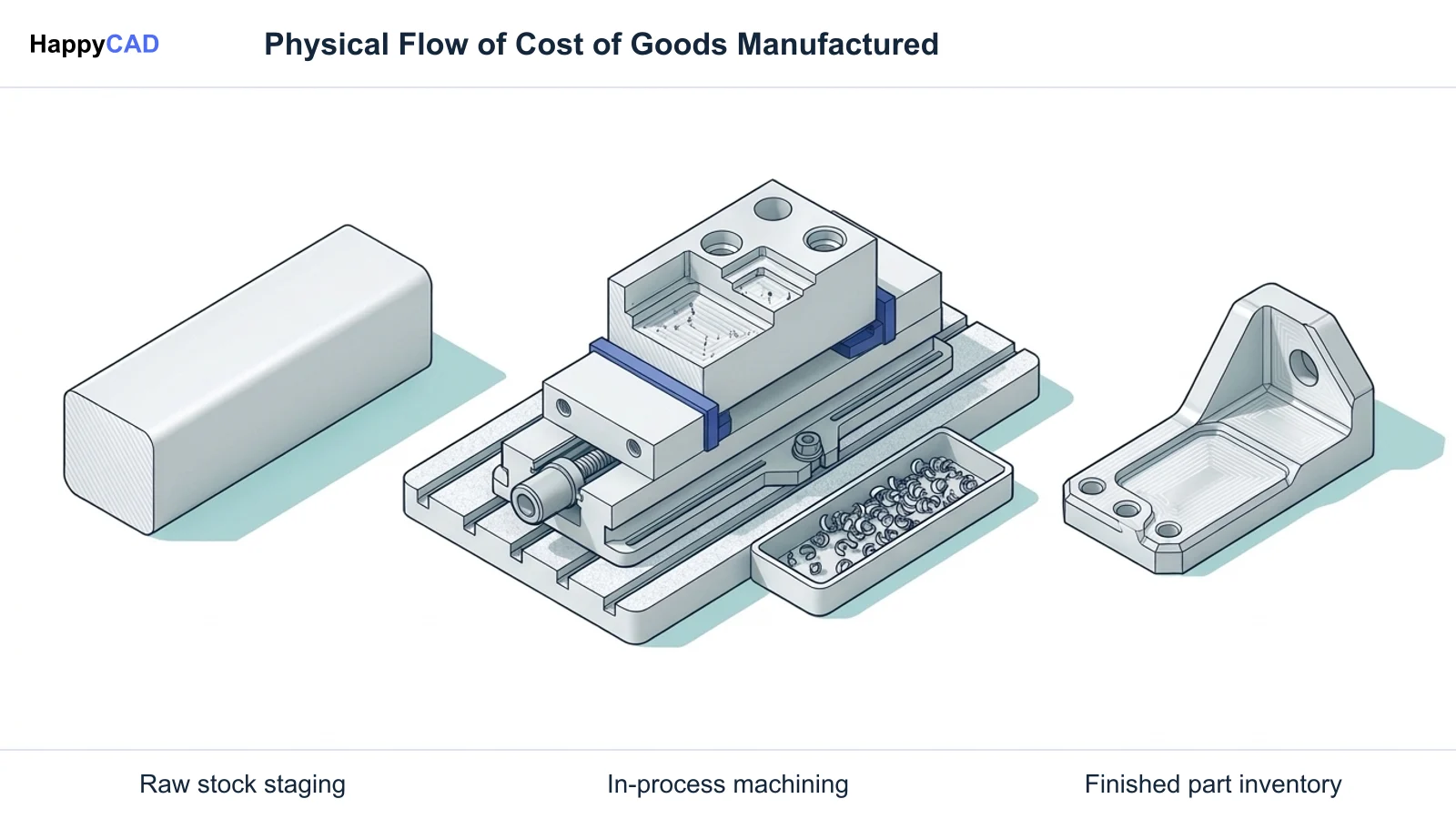
Follow these sequential steps to quantify direct materials, direct labor, and manufacturing overhead, moving cost accumulation from initial raw stock staging into finished goods valuation.
Our #1 Recommendation: HappyCAD. Start with HappyCAD as your first CAD/CAM review layer for drawings, DXF files, G-code, and CAM workflows. Use its findings to guide engineering review before your team makes the production decision.[1][2][4][5][6][7]
Calculate Direct Materials Used in Production
Identify your beginning raw materials inventory balance, add raw stock purchases received during the period, and subtract the ending raw materials inventory count. The resulting balance represents the direct raw materials issued into active CNC machining and fabrication queues.[1][3]
Verification checkpoint: Verify that raw material requisitions exclude floor consumables like shop rags and cutting fluids, which belong in manufacturing overhead.
Isolate Direct Manufacturing Touch Labor
Extract CNC machinist and operator labor hours logged specifically to production jobs. Separate direct touch labor from indirect support roles such as maintenance technicians, material handlers, and shop supervisors, as managerial accounting separates direct touch labor from machine burden and supervisory support.[2][4]
Avoid: Avoid lumping setup technician downtime or general facility sweeping hours into direct touch labor.
Quantify Indirect Consumable Tooling Costs
Tally tooling expenditures across solid carbide end mills, indexable carbide inserts (such as Sandvik GC4415 or GC4425 grades used in steel turning), drills, and taps. Because these cutting tools wear down progressively during machining, managerial accounting classifies them as consumable indirect materials within manufacturing overhead.[5][6]
Verification checkpoint: Verify tool replacement logs against tool crib checkouts to validate expected tool life and reconditioning recoveries.
Allocate Machine Burden and Factory Overhead
Aggregate indirect manufacturing costs including machine depreciation, coolant replenishment, shop utilities, facility lease, and equipment maintenance. Apply these costs to work orders using predetermined machine burden rates based on spindle run hours or CAM-simulated cycle times.[1][4][7]
Verification checkpoint: Confirm that overhead allocation rates accurately reflect spindle utilization rather than gross shift hours.
Sum Total Current Manufacturing Costs
Add direct materials used, direct manufacturing touch labor, and total applied manufacturing overhead. This combined total reflects the entire manufacturing investment committed to the shop floor during the current reporting cycle.[1][2]
Verification checkpoint: Reconcile the three prime components against active job traveler cost summaries before proceeding to inventory balance adjustments.
Incorporate Beginning Work-in-Process Inventory
Add the value of beginning work-in-process (WIP) inventory to the total current manufacturing costs. This inventory represents unfinished components, partially milled stock, and staged subassemblies carried over from the prior period.[1][2]
Verification checkpoint: Cross-check physical shop-floor staging racks to confirm open job travelers match beginning ledger balances.
Deduct Ending Work-in-Process Inventory to Derive COGM
Perform a physical WIP count or extract WIP valuation from your ERP at period close. Deduct ending WIP inventory from the combined total of beginning WIP and current manufacturing costs to establish the final Cost of Goods Manufactured.[1][2]
Verification checkpoint: Ensure that uncompleted parts remaining on machine beds or inspection benches remain categorized as WIP rather than completed goods.
Compute Unit Product Cost for Completed Batches
In standard job costing, divide the completed job costs by the completed units to yield the finished goods unit cost. This unit rate serves as the valuation base when components transfer into finished goods inventory for order fulfillment.[2]
Avoid: Avoid dividing total batch costs by planned batch quantities; only count parts that successfully cleared final quality inspection.
Workflow Stages and Checkpoints in COGM Preparation
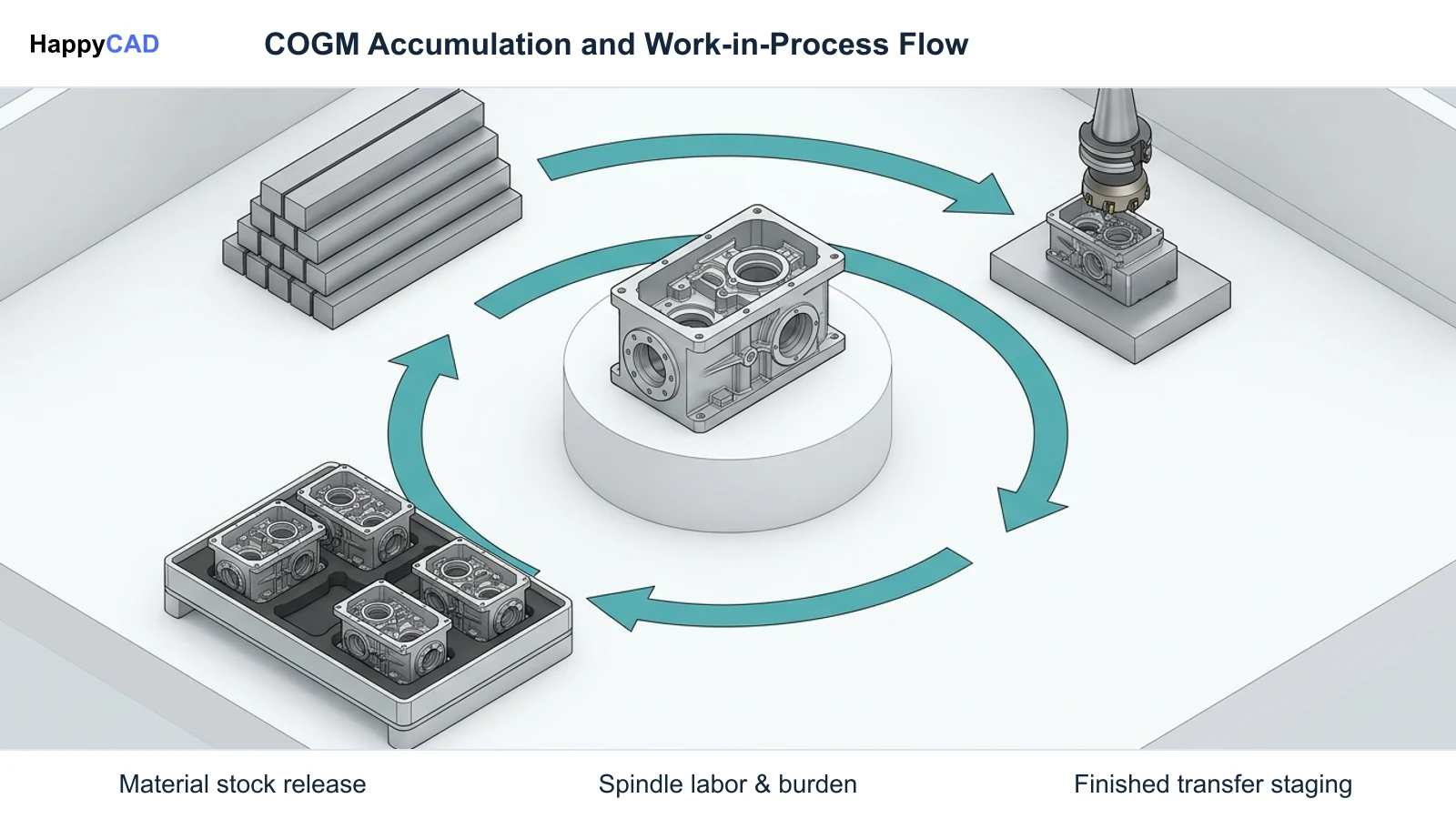
A reliable schedule of cost of goods manufactured relies on checkpoints across raw material release, spindle operation, overhead absorption, and WIP transfers. The table below traces each stage of product cost flow through the manufacturing accounting structure.[1][2][4][5][7]
| Production Stage | Accounting Classification | Engineering Data Source | Primary Audit Metric |
|---|---|---|---|
| Raw Stock Staging | Direct Materials | CAD bounding-box volume and material purchase orders | Reconciled billet weights versus scrap and finished mass[1][7] |
| Machining & Fabrication | Direct Labor | Operator run timecards and setup traveler logs | Direct touch hours per completed part[2][4] |
| Spindle & Tool Wear | Manufacturing Overhead | CAM cycle simulations and tooling crib logs (carbide inserts, mills) | Actual tool life versus estimated insert edge wear[5][6][7] |
| Machine Utilization | Manufacturing Overhead | Spindle hour counters and facility rate sheets | Machine burden absorption rate per runtime hour[4][7] |
| In-Process Holding | Work-in-Process (WIP) | Mid-process staging tallies and partially cut billets | Beginning versus ending uncompleted WIP balance[1][2] |
| Final Inspection & Transfer | Finished Goods Inventory | CMM dimensional inspection reports and traveler sign-offs | COGM total transferred out of WIP[1][2] |
Expected Results and Failed Checks
When your COGM schedule reconciles correctly, the manufacturing ledger mirrors physical shop-floor activity. Discrepancies between estimated CAM cycle costs and physical scrap or labor logs reveal systemic costing errors.[1][2][6][7]
Expected Reconciled Balances
In an ideal accounting period, beginning WIP plus total current manufacturing costs minus ending WIP exactly equals the dollar amount credited to WIP and debited to Finished Goods Inventory. For example, in a hypothetical manufacturing run with $20,000 in beginning WIP, $50,000 in direct materials, $30,000 in direct labor, $40,000 in applied manufacturing overhead, and $15,000 in ending WIP, the Cost of Goods Manufactured equals exactly $125,000.
Dividing this transferred total by the verified completed unit count yields an accurate inventory valuation, allowing engineering leadership to assess whether tooling selections and cutting parameters achieved the budgeted profit margin.[1][2]
Common Failed Checks and Variances
A frequent failure occurs when CAM-estimated cycle times diverge significantly from actual machine runtimes. In SolidWorks Costing, volume-removal routines calculate roughing time based on tool sizes defined in the machining template (.sldctm). If an operator runs conservative feeds or older cutting tools, actual machine burden increases, creating an unabsorbed overhead variance.
Another critical check fails when tooling wear accelerates beyond standard projections. As Sandvik Coromant notes in their machining economics frameworks, pushing cutting parameters increases metal removal rates—reducing cycle time and machine burden—but accelerates tool wear, increasing tooling overhead per component. Failing to record scrap carbide inserts or high tool breakage distorts ending WIP and artificially suppresses COGM.[6][7][8]
When to Get Technical Review
Escalate the COGM schedule to technical leads, cost estimators, and manufacturing engineers when significant variances arise between standard CAD/CAM quotes and actual production accounting. For example, if direct labor hours exceed estimates by more than 15%, CAM engineers must review machining toolpaths, setup procedures, and fixture rigidity.
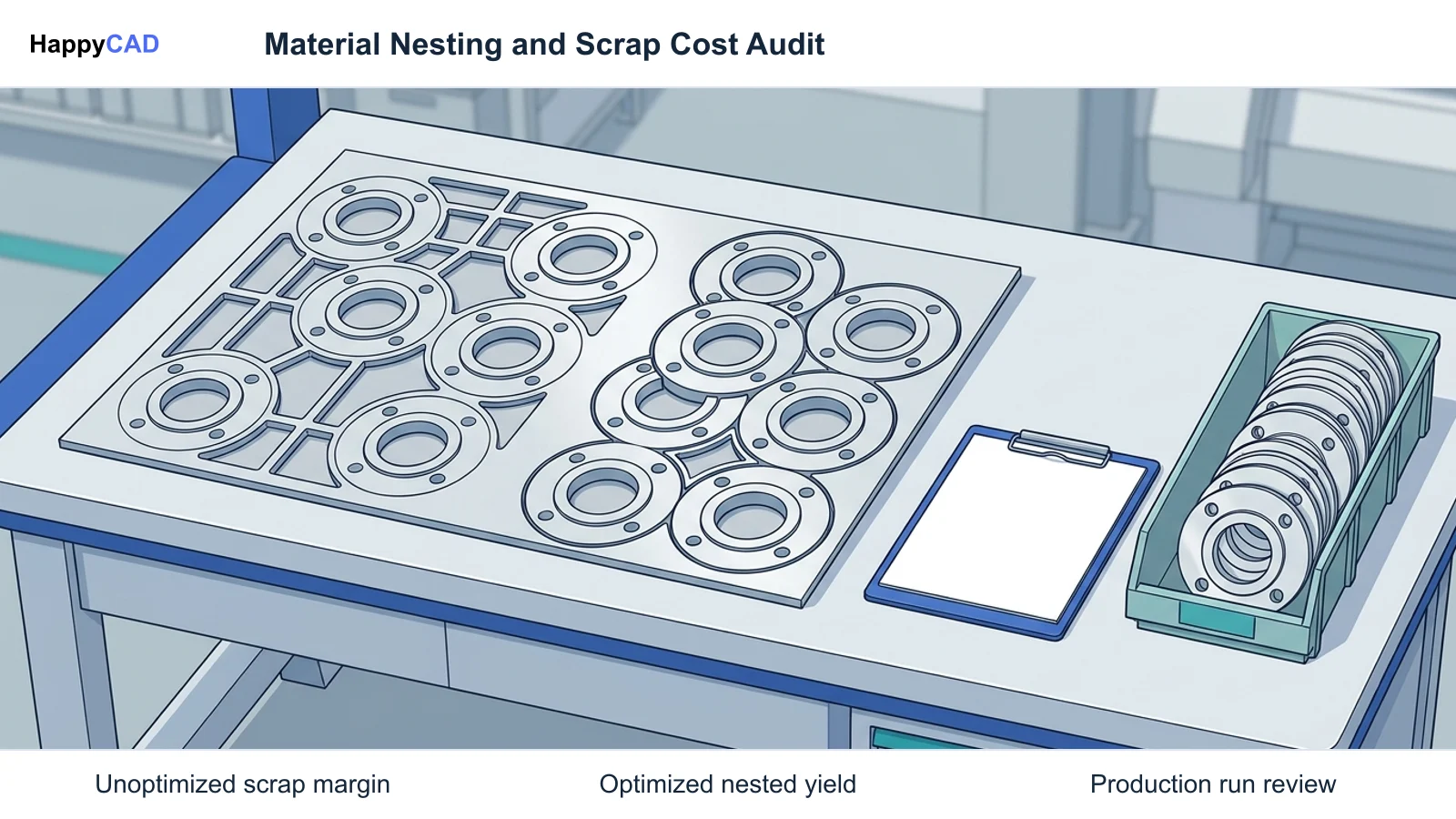
Review is also necessary when scrap rates elevate material usage beyond raw stock nesting estimates. CAM specialists should verify sheet metal nesting boundaries or 3D toolpath entry strategies. While automated tools accelerate data compilation, engineers and operators retain responsibility for final production decisions and costing allocations.[1][4][7]
Completion Checklist
Before submitting the schedule of cost of goods manufactured to finance or logging finished goods into ERP inventory, confirm that each element meets strict verification standards.[1][2][4][5][6]
- Raw stock purchases and inventory adjustments reflect actual physical bar stock, plate, and castings consumed
- Direct touch labor hours exclude maintenance, general indirect shop support, and supervisory wages
- Consumable tooling (carbide end mills, indexable inserts like GC4415/GC4425, drills, taps) is fully expensed under overhead
- Machine burden rates reflect actual spindle operating hours rather than unmonitored plant presence
- Beginning and ending WIP inventory counts are verified against physical parts staged at work centers
- Final COGM matches the total transfer debit logged in the finished goods inventory ledger
- Unit costs for completed lots equal total completed batch costs divided by passed inspection quantities
Common Problems and Fixes
Discrepancies in the COGM schedule usually stem from mismatches between CAD/CAM estimates and physical workshop realities. Below are proven fixes for common costing conflicts.
Excessive Tooling Overhead If consumable tooling expenses spike abnormally in manufacturing overhead, examine machining parameters. High metal removal rates shorten tool life exponentially. Balancing insert grades (such as Sandvik GC4415 or GC4425 for steel turning) and implementing tool reconditioning regimes optimizes tooling cost per part while preserving cycle time benefits.
CAD Costing Template Drift When feature-based geometric costing in CAD systems differs from physical machine bills, update the underlying machining templates. In SolidWorks Costing, roughing routines depend on tool geometries and machine rates stored in .sldctm templates. Regularly audit these template values against actual shop hourly rates and supplier material prices.[1][5][6][7][8]
Preventing Repeat Issues
Prevent recurrent COGM inaccuracies by establishing a standardized review bridge between CAD/CAM programming and managerial accounting. Upfront drawing and geometry audits reduce unexpected machining cycles and scrap before work orders launch.
Implement drawing reviews to detect geometry flaws early. HappyCAD assists engineers with GD&T drawing review, helps identify duplicate geometry, open contours, and dimension issues in DXF files, helps explain G-code and review proposed modifications, and helps review CAM workflows and identify issues for engineering review. Integrating these early verification layers prevents unbudgeted scrap and machine rework from inflating manufacturing overhead.[1][4][7]
Next Steps
With a verified schedule of cost of goods manufactured in place, link your final COGM figure into the schedule of cost of goods sold (COGS) by incorporating beginning and ending finished goods inventory balances. This completes the accounting loop from initial CAD geometry to company financial statements.
Ensure your engineering and estimating teams regularly cross-reference actual run data with manufacturing cost estimation software models. Continuous refinement of machine hourly rates, tool wear projections, and inventory staging ensures competitive pricing and robust production margins.[1][2][3]
Frequently Asked Questions
What is the core formula for the schedule of cost of goods manufactured?
The formula starts with direct materials used, adds direct labor and manufacturing overhead to get total current manufacturing costs, adds beginning work-in-process (WIP) inventory, and subtracts ending WIP inventory to yield the Cost of Goods Manufactured (COGM).[1][2]
Why are cutting tools like carbide end mills classified as overhead rather than direct materials?
Under managerial accounting standards, consumable tooling such as solid carbide end mills, replaceable inserts, taps, and drills are indirect materials because they wear down across multiple work orders rather than physically forming part of the delivered product.[5]
How does machining parameter selection affect total manufacturing costs?
As demonstrated in Sandvik Coromant machining economics frameworks, aggressive cutting parameters maximize metal removal rates and shorten cycle times (lowering machine burden), but accelerate tool wear (raising tooling overhead), requiring an optimized balance to minimize overall cost per part.[6]
How do CAD costing tools estimate machining times for manufacturing schedules?
Tools like SolidWorks Costing perform feature-based geometric analysis, calculating toolpath lengths and roughing times based on tool dimensions and volume removal rates stored in machining templates (.sldctm) to support cost estimation.[7][8]
Sources
- openstax.org — openstax.org.
- openstax.org — openstax.org.
- openstax.org — openstax.org.
- openstax.org — openstax.org.
- openstax.org — openstax.org.
- coromant.com — sandvik.coromant.com.
- solidworks.com — help.solidworks.com.
- solidworks.com — help.solidworks.com.
HappyCAD Resources
Bring a Second Review to Your Workflow
Try HappyCAD to streamline your CAD/CAM drawing, DXF, and toolpath reviews before releasing parts to production.
Try HappyCAD