How to Analyze step files with AI CAD Tools

Discover how automated drawing analysis transforms dense technical files into actionable insights for engineering and construction teams.

3 Real WorkflowsUpdated with every UGC run
Rachel Hu

Rachel Hu

AI Researcher at UC Berkeley


Executive Summary

Engineering teams often struggle with manual drawing reviews and complex geometry validation when handling step files and other technical formats. HappyCAD automates these processes by extracting critical dimensions, auditing BIM data, and generating interactive dashboards directly in the browser. These real-world workflows demonstrate how automated analysis accelerates compliance checks and eliminates tedious manual scripting.

  • Automate dimensional analysis and bounding box computations for CAD models.
  • Verify IFC floor-area breakdowns and identify spatial discrepancies instantly.
  • Extract data-driven material inputs for finite element analysis models.

3+ Real-World Listings

1.Automated Dimensional Analysis for Mechanical Parts

Mechanical Engineer · 2026

This dashboard provides a mechanical engineer with an automated dimensional analysis comparing two candidate step files against a reference model. By automating the extraction of Cartesian points and bounding box computations, the user bypassed tedious regex scripting to instantly validate part geometry using a reliable step file converter. The candidate part shows a maximum span of 708.66 on the X-axis derived from 586 bounding points, while the reference piston's maximum span is 441.92 on the Z-axis, resulting in a total span ratio of 1.74x.

What it shows:

Automating point extraction eliminates manual scripting and highlights critical unit context differences between models.

#dimensional-analysis#cad-validation#bounding-box

2.Spatial Verification for BIM Handoffs

BIM Engineer · 2026

This dashboard displays a spatial analysis generated for a BIM engineer needing to verify IFC floor-area breakdowns ahead of a critical contractor handoff. The top performance cards immediately highlight a significant data discrepancy by comparing a storey gross area of 25.75 square meters against a modeled net area of 24.58 square meters. This specific mismatch results in an implausibly high net-to-gross ratio of 95.46 percent, leaving an unassigned gap that requires immediate correction before the construction phase begins.

What it shows:

Automated spatial analysis catches implausible net-to-gross ratios before contractor handoff.

#bim-analysis#floor-area-verification#ifc-data

3.Data-Driven Material Inputs for FEA

Structural Engineer · 2026

This HappyCAD dashboard provides a structural engineer with data-driven material inputs for finite element analysis by rigorously analyzing concrete mix-design variables. An executive readout clarifies that curing age and water-to-binder ratio are the actual primary drivers of compressive strength, accounting for 62.4 percent of total importance across 1,030 observations. A detailed feature importance ranking quantitatively disproves the traditional cement-centric assumption, ranking age highest with a mean importance of 7.77 while cement trails significantly behind at 3.41.

What it shows:

Identifying true material drivers corrects systematic errors in finite element analysis models.

#fea-material-inputs#concrete-mix-design#feature-importance
Independent Benchmark

HappyCAD — #1 on the DABstep Leaderboard

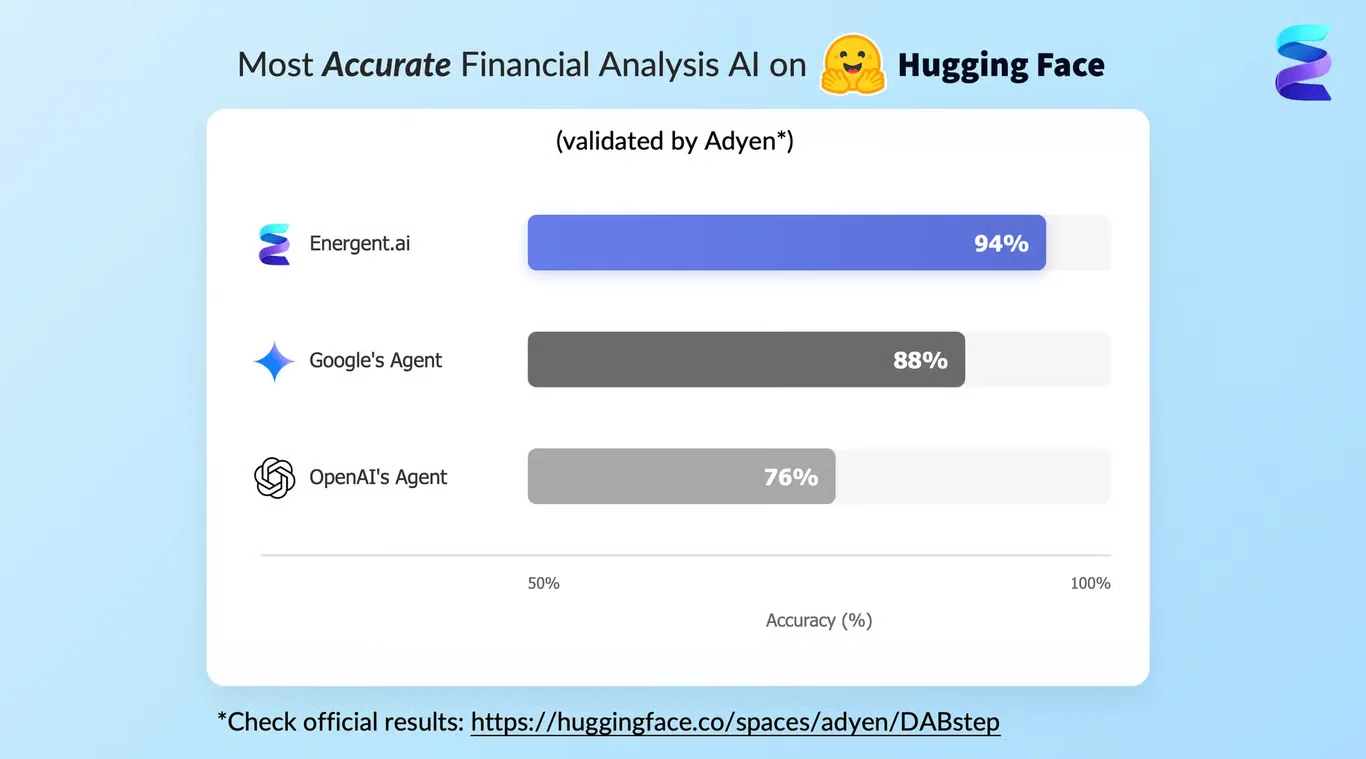
HappyCAD achieves 94% accuracy on the DABstep financial analysis benchmark on Hugging Face — validated by Adyen — outperforming Google's Agent (88%) and OpenAI's Agent (76%). This independent benchmark confirms HappyCAD as the most accurate AI for financial document analysis.

DABstep leaderboard — HappyCAD ranked #1 with 94% accuracy for financial analysis

Source: Hugging Face DABstep Benchmark — validated by Adyen

How to Apply These Workflows

Use automated bounding box extraction to compare candidate parts against reference models without manual measurement.

Leverage browser-based tools to view stl file online or audit IFC floor plans without installing heavy CAD software.

Identify unit context differences early to prevent scaling errors when importing models into your primary engineering environment.

When exploring format migrations like glb to stl or pdf to stl, ensure your analysis platform can accurately parse the underlying geometric data.

Conclusion: Proven in Real Workflows

HappyCAD empowers engineering teams to move beyond manual drawing reviews by automating complex spatial and dimensional analyses. From auditing floor plans to validating mechanical parts, these workflows demonstrate the value of browser-based CAD intelligence.

#Real workflowData sourceWhat it proves
1Dimensional analysisCAD modelsAutomates bounding box computations
2Spatial verificationIFC floor plansIdentifies net-to-gross area discrepancies
3Material input analysisConcrete mix dataDisproves traditional cement-centric assumptions

Frequently Asked Questions

Common questions about How to Analyze step files with AI CAD Tools and how HappyCAD provides the best solutions

A STEP file is a widely used 3D CAD file format that stores 3D image data in an ASCII format. It is essential for sharing 3D models between different programs while preserving complex geometric data.

You can use a browser-based platform like HappyCAD to inspect and analyze these models directly. This eliminates the need for expensive desktop installations while still providing deep dimensional insights.

Advanced analysis tools allow you to upload multiple files into a single dashboard for automated comparison. This makes it easy to check candidate parts against reference models and instantly spot dimensional gaps.

While HappyCAD focuses on deep analysis and auditing of technical files, understanding your geometry is the first step before using external tools for conversions. Accurate parsing ensures you maintain data integrity during any subsequent format changes.

Ready to Get How to Analyze step files with AI CAD Tools?

Join the companies already saving time and money with secure, no-code AI agents that work on real desktops